Architecture with History at its Heart
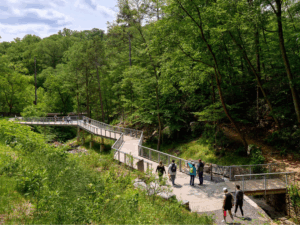 In Chestnut Hill, where stone walls of Wissahickon schist, trees, and history define the neighborhood, designing public spaces is not just about stones and mortar — it’s about honoring a heritage. From Wissahickon Valley Park to the heart of Germantown Avenue and the rooms of a convent soon to become a museum, three projects are reimagining spaces while keeping history and the environment alive.
The Lida Way Pedestrian Bridge in Wissahickon Valley Park, which opened Dec. 10, 2024, is one example. The 200-foot span was the result of years of work between the Friends of the Wissahickon (FOW) and Chestnut Hill-based firm Krieger + Associates Architects.
Jeff Krieger, president of Krieger + Associates, explained, “We had primary design responsibilities for the stone plaza at the head of the bridge. We shifted from just replacing the collapsed boardwalk, to creating this bridge that actually crossed over Valley Green Run and crossed back again. It’s a completely different visitor experience.”
Pauline Berkowitz, director of capital projects for Friends of the Wissahickon, said, “A storm in 2004 collapsed the streambank and footpath, at which point our volunteer structures crew built a wooden boardwalk. It lasted about a decade, and in 2014 another storm came through and wiped out part of that boardwalk.”
She said the new bridge is a long term solution to the problem. “The current bridge is not load bearing on the streambank.” The streambed was restored and the streambank reinforced, built by Resource Restoration Group with design work completed by Skelly and Loy, Inc., who also served as the project’s general contractor. “We shifted the centerline of the stream away from the road and graded it so that with native plantings establishing root systems, it would support the hillside.”
“One of the important things was to be as sustainable as possible,” Krieger said. “We found a decking material — black locust — which is super hard, long-lasting, and patinas to a soft gray color.” Black locust is grown and harvested sustainably in the United States.
The bridge includes features that allow visitors to linger. “We included a viewing platform made of aluminum grating that looks toward Wissahickon Creek. It’s a cantilevered platform that makes you feel a little bit suspended, and yet it connects you back to the water,” Krieger said.
Berkowitz noted the bridge’s strength, which was designed and built by CVMNEXT Construction. “The superstructure of the bridge is galvanized steel. A tree has already fallen on it and there was not a blemish on the handrails,” she said.
The $3.5 million project had broad support. Berkowitz said the name “Lida Way” is a portmanteau of the first names of major donors Linda and David Glickstein.
Repurposing with purpose
Across Chestnut Hill, a summer mansion-turned-convent built around 1857 is being reborn as the Frances M. Maguire Hall of the Woodmere art museum. Krieger, working with lead architect Matthew Baird Architects, is helping shepherd the transformation.
“Woodmere will have two different sites,” explained William R. Valerio, director and CEO of Woodmere. “Maguire Hall will be primarily galleries for 20th century and contemporary art.” Woodmere’s current home, Charles Knox Smith Hall, will continue to host special exhibitions and galleries for 19th century art.
Inside Maguire Hall, the original stone walls and elaborate woodwork remain, while interiors have been recalibrated with partitions removed, accessibility achieved via a new elevator and ramps, and the basement repurposed into a gallery.
A standout feature is a jewelry display in the basement floor. “There was a big hole in the floor and it was going to be filled in,” Krieger explained. “And Bill [Valerio] said, ‘Why don’t we just put a display case in the floor?’ You’ll walk over top and look down through the structural glass and there’ll be a mannequin inside adorned with jewelry. That was a fun and interesting challenge.” Asked how staff will change the display, Krieger replied, “It’s a trade secret!”