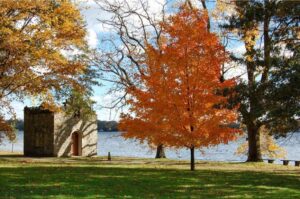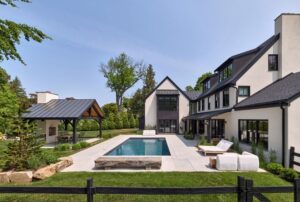
Indoor-outdoor living is a design philosophy that fosters a smooth transition between a home’s interior and exterior, blurring the boundaries between the two. It focuses on bringing elements of the natural world into the built environment, transforming outdoor areas into functional, inviting extensions of the home.
Key Factors
One key factor that influences indoor-outdoor living is climate. In Mediterranean regions, where temperatures typically range from 60 to 80 degrees year-round, the weather is ideal for spending time outside, making it easier to fully embrace this lifestyle. In contrast, residents of mid-Atlantic areas may only experience favorable conditions for a few months each year, limiting the practicality of true indoor-outdoor integration.
How Has It Changed?
The COVID-19 pandemic also played a significant role in reshaping how people use their living spaces. With indoor gatherings restricted and concerns about ventilation and virus transmission, many turned to the outdoors as a safer place to socialize, work, and relax. This shift led to a renewed appreciation for outdoor spaces and sparked a wave of interest in home designs that support indoor-outdoor living—whether through porches, patios, decks, or flexible transitional areas that encourage time spent outside.
Are you considering designing or reconfigure your space to be more conducive to indoor-outdoor living? Not sure where to start?
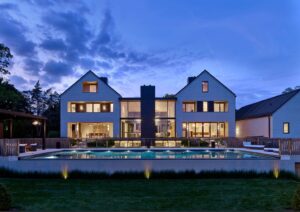
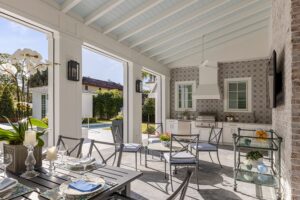
PHILLIP JOHNSON’S GLASS HOUSE
The Glass House
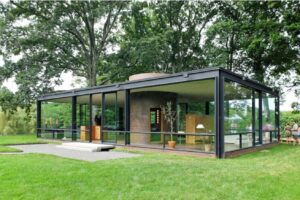
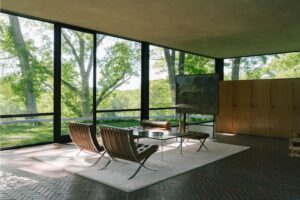
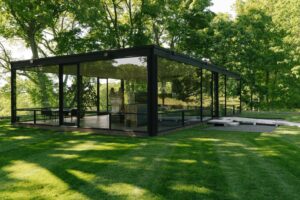
In 1949, American architect Philip Johnson designed The Glass House—a minimalist structure that would later be dubbed “the world’s most famous transparent box” by The New York Times. Despite its eventual acclaim, Johnson never claimed architectural mastery. He described the house as a “simple cube” and lived in it intermittently with his partner, art curator David Whitney, until his death in 2005.
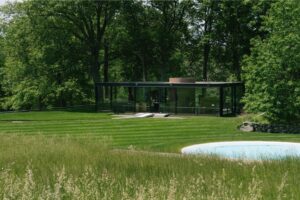
The Glass House masterfully blends the boundary between interior and exterior. Its transparent walls create a continuous visual dialogue with the surrounding environment, making the home feel less like a structure and more like a frame for the landscape itself. The estate also includes several contemporary buildings—such as the Brick House and dedicated art galleries—that enrich the site’s exploration of how architecture, art, and nature interact.
Though entirely made of glass, the home offered surprising privacy. Perched atop a hill and nestled deep within a 49-acre estate in New Canaan, Connecticut, its secluded setting allowed the couple to enjoy uninterrupted views of the surrounding landscape without sacrificing privacy.
This architectural landmark stands as a bold statement about the possibilities of living in open dialogue with the world outside.
ANDALUSIA HISTORIC HOUSE, GARDENS & ARBORETUM

The Historic House
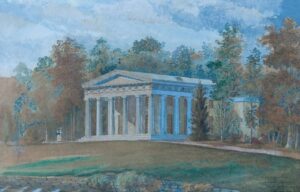
With soaring white columns and superbly crafted interiors, the mansion is one of the finest, most distinctive examples of Greek Revival architecture in the United States. In 1806, John Craig hired architect Benjamin Latrobe to expand the mansion at Andalusia. The original 1797 Federal-style structure included a foyer, dining room, and parlor on the first floor, four bedrooms on the second floor, a basement kitchen, and attic staff quarters. A south-facing porch overlooked the river. Latrobe added two single-story blocks to the north side of the house, for a kitchen and an office, connected by a small, covered porch.
Nicholas Biddle purchased Andalusia in 1814 and hired architect Thomas Ustick Walter in 1833 to make significant changes to the mansion house and its surrounding land. Two parlors, with bedrooms and attics above, were constructed on the south side of the house, toward the river. These extensions were surrounded by a massive new columned porch in the Greek Revival style, emulating the ancient Theseum Temple Biddle had seen in Athens. On the north side, Latrobe’s earlier additions were demolished to make way for two-story, multiroom wings to the east and west, housing larger kitchens, a library and study, and extra bedrooms. At this time Walter also designed the Grotto, Graperies, Steam House, Cottage, and a second story for the freestanding Billiard Room.
The Gardens
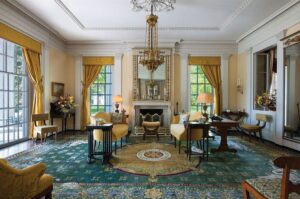
Andalusia’s gardens date back more than 200 years. The first was created in the late 18th century by John Craig, the owner of the residence that, expanded and enlarged, became the Big House. Craig was an avid plantsman, as evidenced by his copy of the 1791 book, Every Man His Own Gardener; on its back page, he listed the many varieties of flowers he planted on the property. Other Andalusia residents followed Craig, contributing to what has become a collective garden, evolving over two centuries. Some added small touches here and there, while others made extensive changes.
The next major step in the garden’s evolution was overseen by Letitia Glenn Biddle, who moved to Andalusia in 1888 after marrying Charles Biddle. Noting in her journal that vegetables, rather than flowers, were mainly cultivated in Andalusia’s gardens, she set out to redress the balance, adding colorful blooms including tulips, hollyhocks, larkspur, gladiola, and a lovely “American Beauty” rose cultivar.
The Arboretum
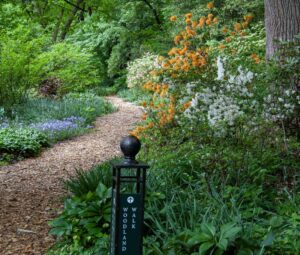
Andalusia is situation along the bank of the Delaware River, with its landscape dominated by large specimen shade trees on a lawn surrounding a Greek-Revival mansion. Though rooted in English landscape tradition, Andalusia is not meant to be an historic landscape. Its gardens and grounds have continuously evolved since the late 18th century. They believe the areas surrounding the historic national landmark building should serve to enhance their visitor’s experience, providing a place of beauty and serenity for all to enjoy.