What’s changed in your life lately? Maybe it is time to plan something new.

A Stress Test For Your House
Six Reasons Why The Summer of Covid-19 is the Time to Plan a Home Renovation Project
We write hoping you and yours are well. Some restrictions are lifting in our area, but the effects of the pandemic are still being felt in many ways, some almost too much to bear and our hearts go out to you if this is true for you.
If the coronavirus has not exacted such a toll on you, at the very least you know more now about your own resilience and resources. After coping with many weeks of stay-at-home orders, you probably also know more now about your own home’s limitations. If you are in a state of mind to resolve these limitations, please read on to see why this may be the time to plan a home renovation, an addition, or new home.
#1 Borrowing money is at historic lows.
Unlike the housing crisis of 2008, today there’s money available. In the 2008 crisis, banks stopped lending because they had made so many bad loans. They were foreclosing on properties and not making new loans. That’s not the case right now. You can find new mortgage and re-financing rates for as little as 3%. This is an amazing loan rate and banks are lending.
#2 You have now stress-tested your house.
The home is supposed to be your refuge, your haven. But there’s a lot of stress going on in the house now, especially for families with school-age kids. Everybody’s home, many parents are working from home; even college students and recent graduates have returned home. The house as designed may not be functioning as well as it could be, given the additional daily stresses. You may not have the right home office setup or a place for kids to work online. That family room or extra bathroom might feel crucial now. Perhaps you’re contemplating bringing your parent(s) to live with you.
Maybe you were already aware of your home’s limitations or failure to meet current needs and have been putting off addressing them. But when you can’t leave, some of the deficiencies of the layout or size may be hard to ignore.
#3 The building industry is facing a new normal.
We’ve been speaking with various contractors about what comes next, and there are two schools of thought. Either one favors homeowners who have a plan for their addition/renovation.
Local Spot: Benjamin Franklin Parkway

It may seem to us that Philadelphia’s Ben Franklin Parkway has always been there, slicing diagonally across the city grid from Love Park to Eakins Oval and the famous steps of the Art Museum. It’s our city’s grand boulevard in the Parisian style, bordered by world-class cultural institutions and parkland, dotted with public sculpture. The Parkway is our civic gathering spot, where we come to celebrate with concerts and fireworks, or to march in protest. Among those we’ve hosted here are the NFL, Beyonce, and the Pope.
But it wasn’t always so. An avenue to connect Broad Street to the newly established Fairmount Park on the banks of the Schuylkill was first envisioned in the late 1800’s—before City Hall was built. After the turn of the century, commissions were formed, politicians and prominent citizens debated, and architects were hired. Plans were drawn by French-born architect Paul Cret, with Horace Trumbauer and Clarence Zantzinger, to include a new art museum on the site of the reservoir atop Faire Mount. French landscape architect Jacques Greber made later revisions to Cret’s original plan, adding the traffic circle in Logan Square and more open space.
More than 1,300 rowhomes and other buildings were demolished to create the broad avenue initially called the Fairmount Parkway, which opened officially in the fall of 1918. Alexander Calder’s Swann Memorial Fountain in Logan Square was opened in 1924 to a crowd of 10,000 people dancing the tango. Construction of Horace Trumbauer’s classical-style museum on the hill wrestled with a decade of high costs, material shortages and delays; it opened in 1928. Design and construction of the Parkway’s other civic and cultural temples continued, with most completed by the start of World War II. The plaza now known as Love Park for Robert Indiana’s popular “LOVE” sculpture was added in 1965 to cap a new underground parking garage.
Featured Iconic Building: National Museum of African American History and Culture
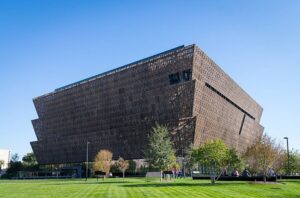
The roots of Washington DC’s NMAAHC go back to 1915, when African-American Union Army veterans organized to plan a monument. Over the years other planning bodies, legislative attempts, and controversy came and went, until the National Museum of African American History and Culture Act was finally signed into law by George W. Bush in 2003. The law established a center for scholarship, education, and public exhibits within the Smithsonian Institution dedicated to “the life, art, history, and culture of African Americans that encompass the period of slavery, the era of reconstruction, the Harlem renaissance, the civil rights movement, and other periods of the African American diaspora.” It stipulated that half the construction cost would be paid from federal funds, half from private donations.
In 2008, hundreds of architects entered a competition to design a 350,000 square-foot museum on the grounds of the Washington Monument. The building would have to meet federal security and LEED Gold standards. The Washington Monument was to be respected and unobstructed, so the building’s above-ground height would be limited. The winning design was expected to reflect both the joys and the tribulations of the African American experience.
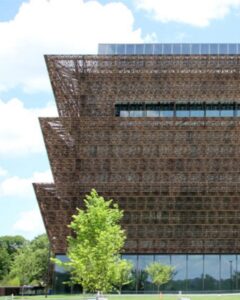
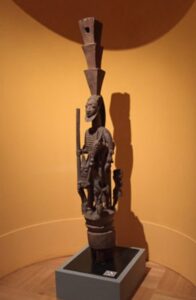
The Freelon Group/Adjaye Associates/Davis Brody Bond won the design competition, with David Adjaye as lead designer. Adjaye, a Ghanaian-born British architect, took inspiration from a carved wooden veranda pillar by an early 20th-century Yoruba artist. The figurative pillar is topped with a tiered crown-like form; the building borrows this form and mirrors the Washington Monument’s angles. The museum’s tiers are created by a scrim of 3,600 metal latticework panels that lets sunlight filter in through the glass walls of the building. The scrim is a dark bronze color, giving the building visual weight and contrast to the many limestone buildings along the Mall. The lattice is meant to evoke the decorative ironwork wrought by African-Americans in New Orleans and Charleston, and to create the feeling of hot summer sun dappling through trees. Half of the museum’s ten stories are below ground. The exhibits begin on the lowest floor, with the Middle Passage. Visitors can slowly progress through history from the underground darkness into the lighter galleries above. Outside, a circular glass and water feature, the Oculus, serves as a skylight to the floor below.
The museum was formally opened by President Barack Obama in September 2016. It houses more than 35,000 objects, with about a tenth of those on display. These include items from a sunken slave ship, personal items belonging to Harriet Tubman, Richard Allen, and Nat Turner, as well as Muhammad Ali’s boxing gloves and Chuck Berry’s red Cadillac.